
Shell Companies and Stolen Identities: Inside the R14m National Lotteries Commission Scam
The Special Investigating Unit (SIU) recently secured a massive victory at the Special Tribunal, successfully reviewing and setting aside a fraudulent R14 million grant awarded by the National Lotteries Commission (NLC) to the Madumelani Community Project.
While the headline another corrupt syndicate ordered to pay back stolen state funds—is familiar, the mechanics of this specific fraud offer a sobering look into the sophisticated tactics used to drain public coffers. Mainstream reports often focus on the final rand amount, but the deeper context of this case reveals an ecosystem of hijacked identities, professional enablers, and a landmark legal strategy by the courts to hold individuals personally accountable.
Here is the factual breakdown of what happened, how the funds were moved, and why this ruling sets a critical precedent.
The Anatomy of a Non-Profit Hijacking
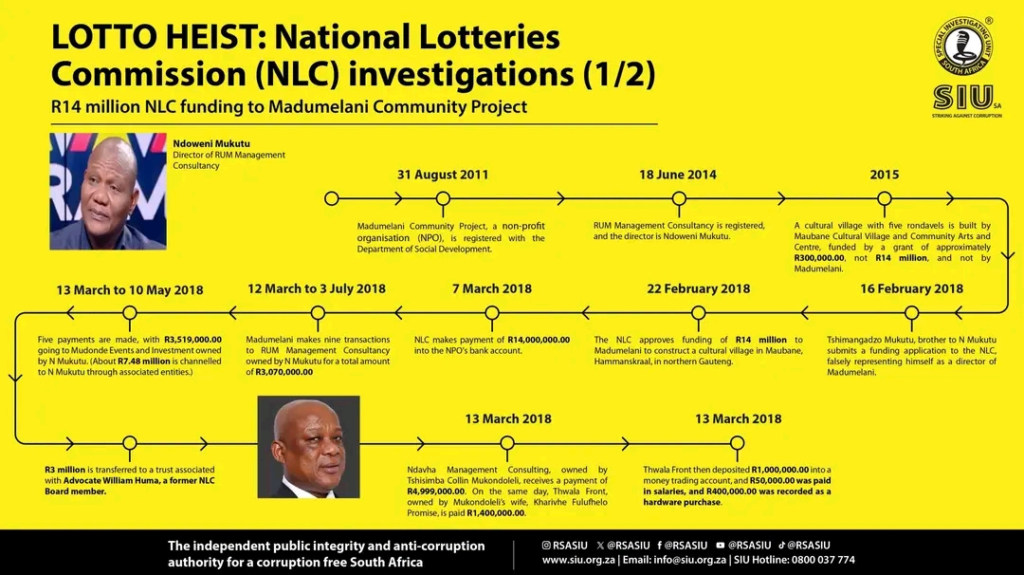
The R14 million grant was approved in February 2018, ostensibly to fund the construction of a cultural village in Hammanskraal, Gauteng. However, SIU investigations revealed a fatal flaw in the premise: the cultural village had already been built in 2015 by a completely different organization (Maubane Cultural Village) using a separate R300,000 NLC grant.
The masterminds, identified as brothers Tshimangadzo and Ndoweni Mukutu, did not build an organization from scratch to apply for the funds. Instead, they hijacked an existing one.
How the identity theft occurred:
The Pretext: The brothers approached the legitimate, original members of the Madumelani Community Project, an existing Non-Profit Organisation (NPO), under the guise of helping them secure funding.
The Theft: Through this relationship, they obtained a copy of the NPO’s constitution.
The Forgery: They subsequently used this constitution without authorization to apply for the R14 million grant. They appointed fictitious office bearers, forged the signatures of the legitimate NPO members, and Tshimangadzo Mukutu fraudulently presented himself as the organization's director.
The Fake Financials: The application was supported by fabricated financial statements, allegedly prepared by Dzata Accountants—a firm the SIU has previously flagged as one of five accounting practices deeply involved in facilitating the looting of NLC funds.
The legitimate members of the Madumelani Community Project later testified that they had absolutely no knowledge of the application or the multi-million rand payout.
Following the Money: The Shell Company Network
Once the NLC approved the grant in February 2018, the funds were deposited into a newly opened bank account. Within months, the R14 million was rapidly dissipated through a network of shell companies and front organizations.
Between March and July 2018, the SIU traced the following major transactions:
Ndhava Management Consulting: Received approximately R4.99 million.
Mudonde Events and Investment (owned by Ndoweni Mukutu): Received R3.5 million.
RUM Management Consultancy: Received over R3 million across nine payments.
Thwala Front: Received R1.4 million (of which R1 million was immediately moved into a money trading account).
Crucially, the money trail also led to a trust linked to Advocate William Huma, a former NLC board member, which received R3 million from the stolen funds. Huma is already a known figure in the NLC corruption saga; last year, the Special Tribunal ordered him to repay R21 million in misused grant funds, and the SIU secured a preservation order against his luxury residence.
The Unreported Significance: Piercing the Corporate Veil
The most critical aspect of this ruling—and one often glossed over in quick news updates—is the legal mechanism Special Tribunal President Judge Margaret Victor used to ensure accountability.
Typically, company directors are protected by "limited liability," meaning their personal assets are shielded from the debts or legal judgments against their companies. However, Judge Victor applied a legal principle known as "piercing the corporate veil." Because the evidence showed extensive planning, deliberate misrepresentation, and a clear intent to defraud the NLC, the court ruled that the front companies (Mudonde Events, RUM Management, Ndhava Management, and Thwala Front) were merely sham entities used to perpetuate a crime.
The result: The limited liability protection was stripped away. The Mukutu brothers, along with their co-conspirators, were held personally liable for the repayment of the R14 million, plus the costs of the legal application. They cannot hide behind liquidated or bankrupt shell companies; the state can now pursue their personal assets.
A "Catastrophic Epidemic"
In her judgment, Judge Victor did not mince words, describing the country's current battle with graft as a "catastrophic corruption epidemic." The ruling highlights a stark vulnerability in South Africa's civil society: grassroots NPOs are actively being targeted and hijacked by sophisticated syndicates who possess the bureaucratic knowledge to game the NLC's application systems.
This SIU victory is not just about recovering R14 million. It is a warning shot to the professional enablers—accountants, lawyers, and consultants—who legitimize fraudulent paperwork, and a legal precedent that corrupt actors will no longer be able to use corporate structures as a shield against personal financial ruin.
In line with its mandate, the SIU has referred the evidence of these fraudulent activities to the National Prosecuting Authority (NPA) for further criminal action.